
The Electric
by Steve LeVine
In his new budget, President Donald Trump all but killed government support for electric vehicles. Not so fast, we write in today’s issue: The administration included billions of dollars in battery and critical minerals funding in the budget for the Pentagon, which now becomes the fulcrum of U.S. support for the battery supply chain.
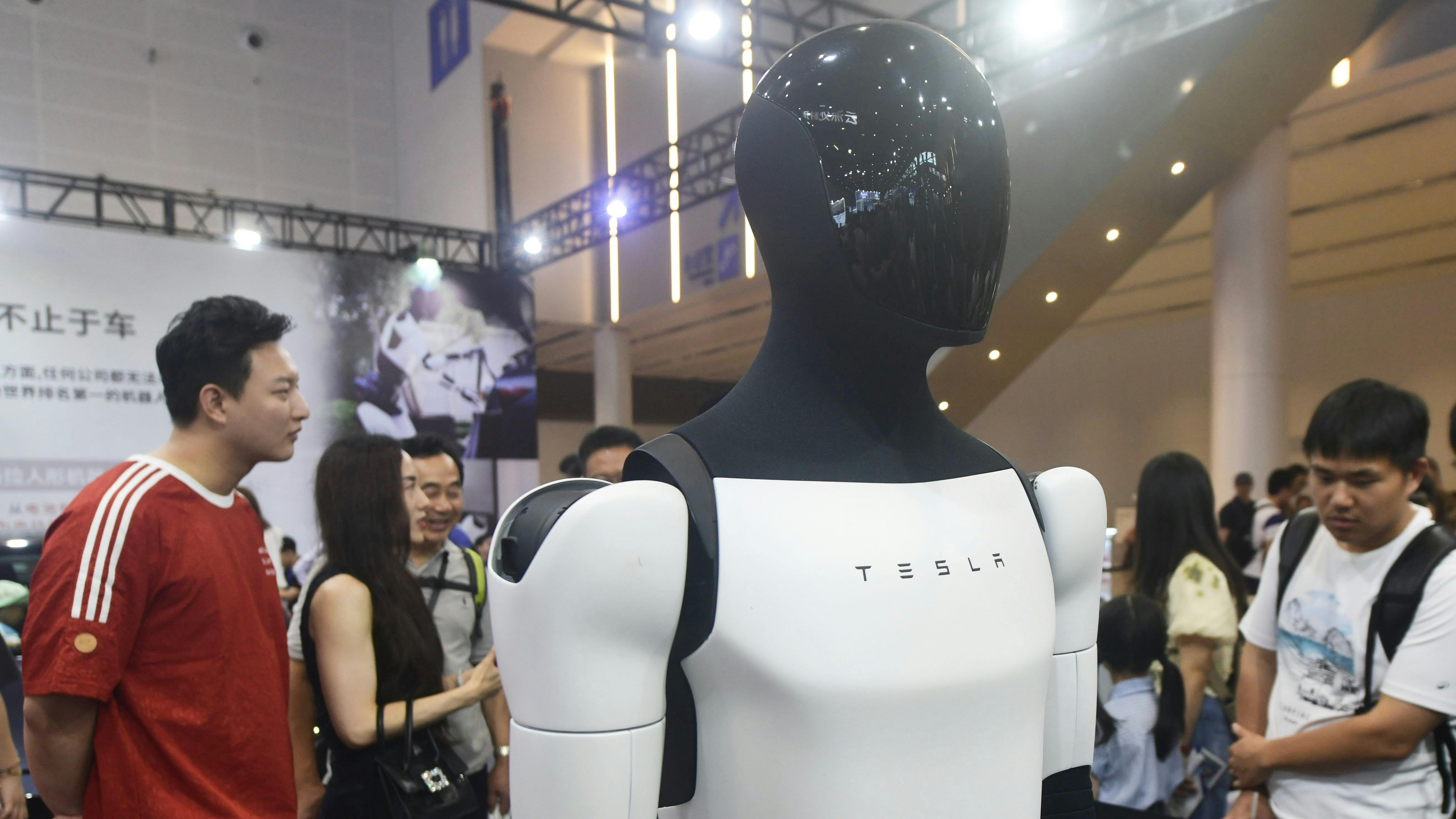 Tesla shows off its humanoid Optimus at an exhibition in Hangzhou, China. Photo: Costfoto/NurPhoto/Getty
President Donald Trump doesn’t like electric vehicles, which he deems unworthy of U.S. strategic support. But he wants the government to spend on drones, humanoid robots, AI data centers and electric aircraft.
The problem is, it is hard to have one without the other.
Trump’s new budget, which he signed Friday, punches a hole in the Biden-era Inflation Reduction Act, which sought to build a U.S. battery supply chain to serve the nascent EV industry and compete with China, the dominant industry player.
But batteries are a crucial technology not only of EVs, but of numerous other key technologies that fall squarely in Trump’s priorities. Batteries power what China calls the “low-altitude economy”—drones, which have transformed warfare; and electric aviation, which U.S. and Chinese startups are racing to develop. They power “physical AI,” including driverless cars and humanoid robots. And they keep AI data centers humming with backup power and surges of energy that help expensive chips train large language models.
That’s why Trump’s budget includes billions of dollars of little-noticed appropriations for a continued battery industry buildout, while slashing government support for EVs and renewable energy. The budget includes:
- $100 billion in lending authority for industrial projects including to make batteries;
- More than $7 billion for investments in critical minerals projects, and to stockpile the metals;
- $1.4 billion for drones and other vehicles, including for batteries that power them; and
- $3.5 billion for industrial manufacturing, including to make batteries.
The funding has shrunk—the IRA and other programs in the Biden era had the authority to dole out more than $500 billion in grants and loan guarantees for battery, critical mineral and other energy projects. The biggest change, though, is which agency is doling out the money. Under Biden, it was the Department of Energy. Under Trump, it will be the Pentagon.
“You might have a situation where you have the deployment of more dollars going to the battery supply chain in the Trump administration than you did in the Biden administration,” said Ben Steinberg, a battery industry lobbyist and executive vice president of Venn Strategies. “Those dollars hit the Defense Department on Oct. 1 in the new fiscal year, and it’s a gold rush again.”
The Battery Economy Broadens
The vast broadening of the battery-driven economy—and the very different political treatment last week in Washington of EVs and the batteries that power them—is a function of significant advances in batteries over the last decade and a half.
When I began to research batteries 15 years ago for a book I was writing, the Nissan Leaf—the only mainstream EV available for sale at the time—went 73 miles on a charge; the batteries that powered the car cost roughly $1,200 per kilowatt hour. Today, EVs like the Lucid Air go 520 miles on a charge, and the most popular EV batteries cost well under $100/kWh.
Today, these much-improved and cheaper batteries facilitate industries that previously were either stunted, or merely aspirational, including robots and drones.
In directives last month, Trump said he sought to unleash “a new era of American aviation dominance,” starting with faster development of drones and electric air taxis. He was following a similar move last year by China, which identified the two technologies as a new engine of economic growth.
China makes more than 70% of the world’s drones, which played pivotal roles in the wars in Ukraine and, five years ago, in Azerbaijan—a prominence that surprised U.S. policymakers. The budget law allocates billions of dollars to significantly increase U.S. production of drones. U.S. battery startups such as Lyten, a San Jose, Calif., developer of advanced lithium sulfur batteries, are aiming their batteries to power such military drones.
As we reported last month, China has also marshalled tens of billions of dollars for a race to develop battery-powered humanoid robots for consumer and military applications.
None of these industries—drones, electric air taxis or humanoids—would be possible without new lightweight, powerful batteries. But U.S. robot developers say the batteries need to get better to power the humanoids longer in demanding settings.
Cutting support for EVs could slow the improvements in batteries that Trump is hoping for. The primary strength of the Chinese battery industry is its scale. Over the last decade, Contemporary Amperex Technology Ltd. and BYD have built enormous battery-making capacity in service of China’s EV industry. Today, the two companies supply more than half of the world’s lithium-ion batteries, most of them to local EV makers.
Here is why that matters: The Tesla Model Y is powered by 4,400 cylindrical batteries. A smartphone contains the equivalent power of one such battery; a humanoid robot may contain 20 or so of them. In other words, EVs demand a lot of battery power. Demand from EV makers is what made China’s battery industry dominant.
Trump’s budget wipes out a $7,500 consumer tax credit for the purchase of new EVs. Industry experts expect consumer demand to fall as a result—and with it a demand signal for battery and critical minerals companies. The Pentagon will buy lots of batteries, but not on the scale of a vibrant EV industry.
“It‘s difficult to set up supply chains for critical minerals if you don’t have the demand pull of a sector that has mass scale like EVs,” said David Kovatch, a lobbyist with Mission Strategies.
“The simplest way to put it is you’re trying to force the EV industry and the battery industry in the United States to kind of underwrite the investment in the defense industrial base,” he said
In other words, though Trump may find it hard to like EVs, they are by necessity a large part of the battery-based economy.
Optimists might say that EVs could still benefit from the growth in the battery industry. What seems likely is that demand from the Pentagon will help U.S. startups begin manufacturing their advanced battery chemistries—most of them have not yet reached the production stage. By the end of the decade, these batteries will be more powerful and cheaper, driving down the cost of EVs with them, which could supercharge the entire U.S. battery-based economy.
“We need the batteries to supply the weapons of tomorrow, including drones and humanoid robots,” said Michael Dunne, a former General Motors executive and an expert on China. “But we may need EVs in order to make the whole ecosystem around the battery supply chain work.”
Noteworthy
China’s BYD has put plans for an EV factory in Mexico on hold. Stella Li, the company’s executive vice president, told Bloomberg that the U.S. trade war had most auto companies “rethinking their strategy in other countries.” In his presidential campaign, Trump threatened a 2,000% tariff on BYD EVs if it built a plant in Mexico and tried to export them into the U.S.
Tesla will lose a major profit stream starting in the fourth quarter: the sale of regulatory credits to its combustion car-making rivals. Until now, carmakers failing to meet U.S. emissions standards were subject to a federal penalty, but they could avoid the payment if they bought credits from competitors. Tesla was a big seller of credits, because it makes only EVs, and hence has no emissions. This year, Tesla seemed to be on track to earn $1 billion from the credits, a big boost in its second tough year in a row. But the Trump administration says it will no longer enforce the emissions rules.
Volkswagen is joining the robotaxi craze. The German carmaker has deployed about 30 driverless VW ID.Buzz vehicles on the streets of Hamburg, branding them Moia, The Wall Street Journal reports. With the cars, VW joins Google’s Waymo and Tesla in the robotaxi race.
Oct 28-29 — The Information’s 2025 WTF Summit
Save the date: The rules are changing—fast. AI, volatile markets, and political uncertainty are reshaping business. Join the boldest women at The Information’s WTF Summit in Napa Valley. RSVP here.
Recommended Newsletter
The Information Weekend, edited by Abe Brown, covers what happens when Silicon Valley logs off—the trends and people shaping culture, technology and everything in between. Subscribe for free today.

0 New comments